
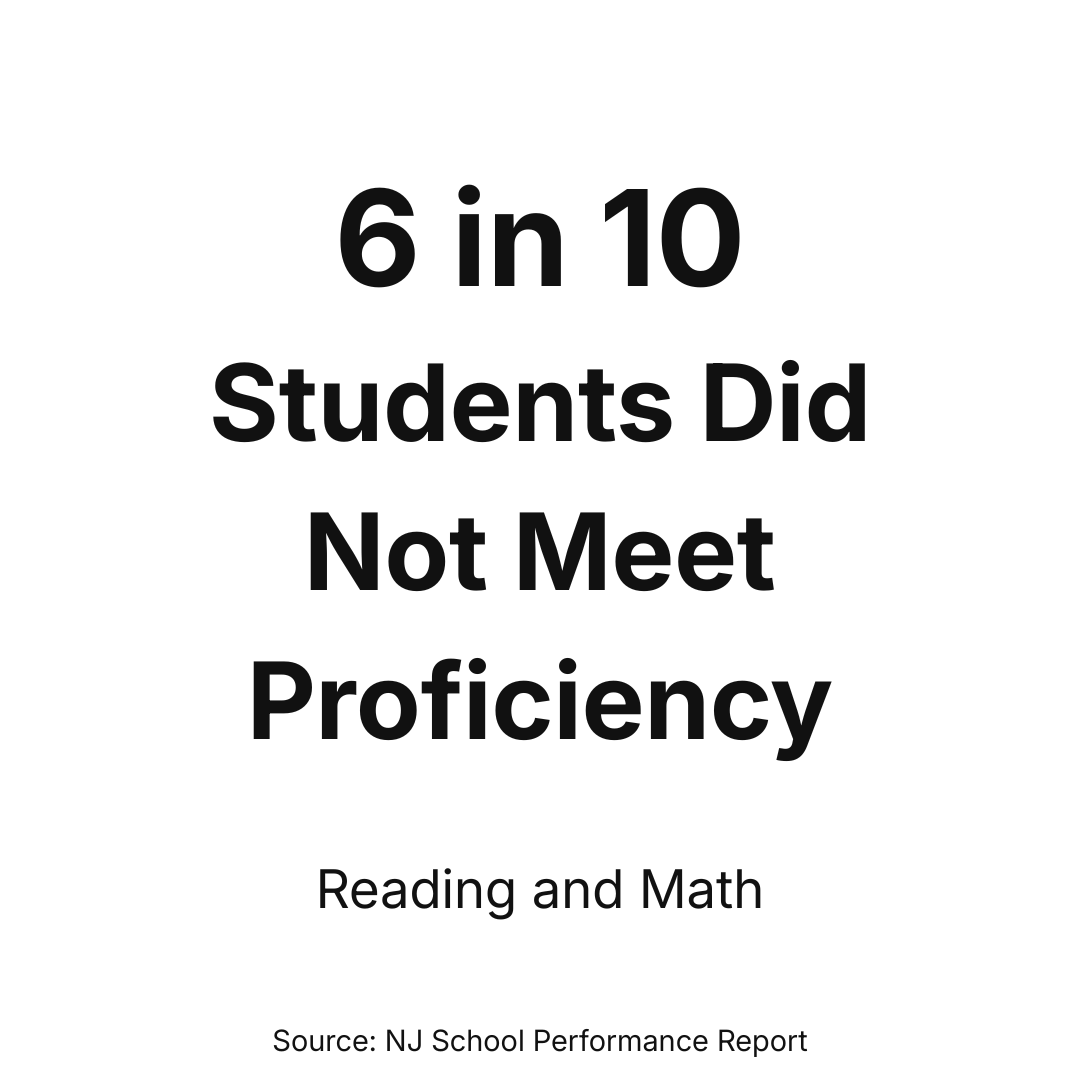

According to the district’s New Jersey School Performance Report, approximately six out of ten students did not meet grade level proficiency benchmarks in reading and math under federal accountability standards.
That reality should be the central focus of every school board meeting. It was not. Yesterday’s meeting instead raised serious concerns about governance, process, and whether board leadership is enabling the changes required to improve student outcomes.
This is not an indictment of our teachers. Our district has many dedicated, capable, and hard working educators who show up every day for our children. The issue is systemic, not personal. Curriculum change is about equipping teachers with better tools and support, not blaming them for systemic shortcomings.
The reality is that the district’s previous curriculum failed QSAC review. That is a structural failure, not a classroom failure. When a curriculum does not meet state standards or produces unacceptable outcomes, leadership has a responsibility to change it. Doing nothing guarantees the same results.
That is exactly what the superintendent is attempting to do: implement necessary curriculum and instructional changes so outcomes can improve. If we do not change, we should not expect different results.
It is important to clarify that what follows is an observation about board leadership dynamics, not a judgment of individual intent.
During this meeting, the board president set nearly all of the public posture and responses. One newly appointed board member asked substantive questions and repeatedly attempted to re-center the discussion on process, governance, and best practice.
The remaining board members were largely silent during these exchanges. Because of that silence, it is difficult to know where they individually stood, whether in agreement or disagreement.
What can be stated objectively is that at the beginning of the meeting, the board nominated and voted on its leadership. All sitting board members voted in favor of the current president and vice president, with the exception of the newly seated board member, who voted no on both positions.
That context matters. Leadership posture does not exist in a vacuum. The public conduct that followed occurred within a leadership structure that had just been reaffirmed by the board.
This dynamic became especially clear in two key areas.
First, regarding anonymous complaint letters against the superintendent, both the superintendent and the newly appointed board member objected to the board’s current practice. They cited best practice, which discourages the consideration of anonymous complaints due to the lack of accountability and due process. Despite those objections, board leadership indicated that anonymous letters would continue to be entertained.
Second, the newly appointed board member raised concerns about the board’s involvement in hiring decisions for positions that report directly to the superintendent. He reached out to the state ethic’s committee to understand their posture on this matter. The state ethics committee stated that boards should only be involved in such hiring decisions when specifically requested by the superintendent.
In Wharton, the board is actively involved in hiring for positions that report to the superintendent. That practice undermines the superintendent’s authority and is not aligned with the ethics guidance cited during the meeting.
The board’s attorney also intervened, stating that the district’s policy allowing this involvement and practice has been in place since at least 2006. Board leadership disagreed with the posture articulated by the state ethics committee.
What was revealed was particularly concerning. At least one candidate was publicly interviewed in open session at public board meetings, which effectively invites members of the public attending board meetings into the hiring process. The newly appointed board member, who previously served on this board for 13 years, stated that he had never seen that practice occur during his prior tenure.
At no point did board leadership or the board attorney demonstrate openness to the possibility that existing policy or long standing practice may need to be revisited to align with current ethics guidance or best practice. Instead, the posture appeared to be that longevity alone justified continuation.
That posture carries risk.
If leadership defaults to “this is how we have always done it” rather than asking whether current practices are appropriate, aligned, and defensible, meaningful improvement becomes difficult. When change is required to produce different outcomes, resistance to examining process is a serious governance concern.
It is also concerning when potential exposure to ethics scrutiny is raised and the response is not thoughtful consideration, but immediate dismissal. This is not to suggest the board’s attorney is wrong. However, the posture and manner in which these concerns were engaged did not reflect the caution or openness one would expect when ethical guidance and potential risk are raised publicly.
All of this occurred while approximately 60 percent of students did not meet grade level proficiency benchmarks in reading and math. That is unacceptable.
Reasonable people may disagree on solutions, but process, leadership clarity, openness to change, and accountability should not be controversial.
These observations are offered in the interest of transparency, good governance, and improved student outcomes.
School board meetings matter. Governance matters. Process matters.
Parents and residents should not assume others will speak up for them. Accountability and transparency only exist when the community is informed and engaged.
If you care about student outcomes, district leadership, and ensuring our teachers are supported by strong curriculum and clear direction, please attend future school board meetings. Our children’s education is counting on it.
